Garage Door Won’t Open in Cold Weather in Austin TX: Complete Troubleshooting Guide
Quick Answer
When your garage door won’t open in cold weather in Austin TX, the primary causes are metal contraction from rapid temperature drops, thickened lubricants that solidify in freezing conditions, and frozen moisture at the door threshold combined with sensor malfunctions. Unlike northern winters, Austin’s unique combination of high humidity and sudden freezes creates condensation on components, particularly affecting safety sensors and causing ice buildup at weather stripping.
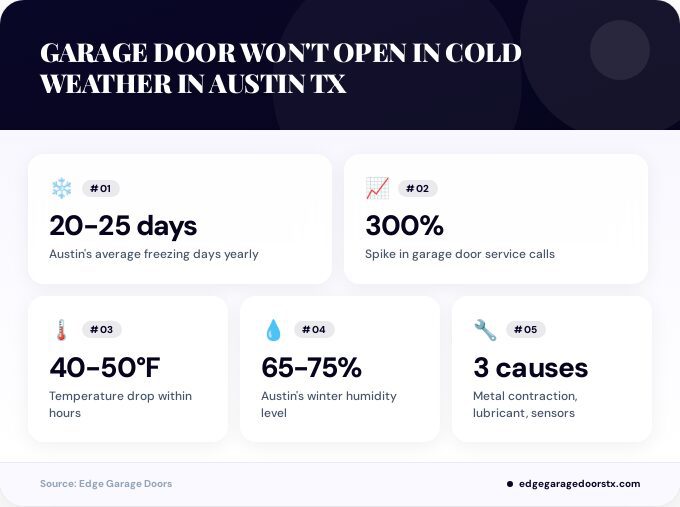
Did you know that Austin experiences an average of 20 to 25 freezing days per year, and during these brief cold snaps, garage door service calls spike by over 300%? When temperatures unexpectedly drop below 32°F in Central Texas, homeowners across neighborhoods from Mueller to Circle C Ranch suddenly find themselves locked out of their garages or unable to close their doors.
The frustration peaks on cold Monday mornings when you’re rushing to work and discover your garage door won’t budge. Unlike homeowners in consistently cold climates who winterize their systems annually, Austin residents often lack the preparation for sudden temperature plunges that can wreak havoc on garage door mechanisms.
This comprehensive guide explains exactly why your garage door won’t open in cold weather in Austin TX, provides actionable troubleshooting steps you can take immediately, and outlines prevention strategies tailored specifically to Central Texas climate patterns.
Why Is Austin TX Cold Weather Different for Garage Doors?
Austin’s winter weather patterns create a perfect storm for garage door failures that differs significantly from traditional cold climate challenges. The city experiences rapid temperature drops rather than gradual cooling, which prevents garage door components from naturally adjusting to changing conditions.
According to garage door specialists tracking Central Texas weather patterns, when Arctic blasts hit the region, temperatures can plummet 40 to 50 degrees within hours. This shock to the system causes immediate mechanical stress on springs, cables, and metal tracks.
Additionally, Austin maintains relatively high humidity levels year-round, averaging 65% to 75% humidity even during winter months. When cold fronts arrive, this lingering moisture doesn’t have time to dissipate. Instead, it condenses on metal components and freezes, creating ice buildup in critical areas like safety sensors positioned near the ground and rubber weather stripping at the door threshold.
What Are the Common Causes When Your Garage Door Won’t Open in Cold Weather?
Understanding the specific mechanical failures that occur during Austin’s cold snaps helps you diagnose problems quickly and determine whether you need professional garage door services in Austin TX or can handle repairs yourself.
Metal Contraction and Component Misalignment
All metal components in your garage door system, including springs, tracks, rollers, hinges, and cables, naturally contract as temperatures fall. Steel contracts approximately 0.0065 inches per foot for every 100°F temperature drop. During a typical Austin freeze that drops from 70°F to 25°F, a 16-foot wide door track contracts nearly 0.05 inches.
This contraction creates several problems. Tracks become slightly narrower, increasing friction on rollers. Gaps appear in hinges that were properly fitted at warmer temperatures. Most critically, spring tension changes as the metal contracts, altering the precise balance required for smooth operation.
Lubricant Solidification
Standard garage door lubricants are formulated for year-round performance in moderate climates. However, when temperatures drop below 32°F, many petroleum-based greases thicken significantly or even solidify, particularly in rollers, hinges, and along tracks.
This increased viscosity forces your garage door opener to work exponentially harder. The motor may hum or strain without moving the door, or it may move the door only partway before the thermal overload protection shuts it down. In extreme cases, the additional resistance can strip gears inside the opener mechanism.
Frozen Threshold and Weather Stripping
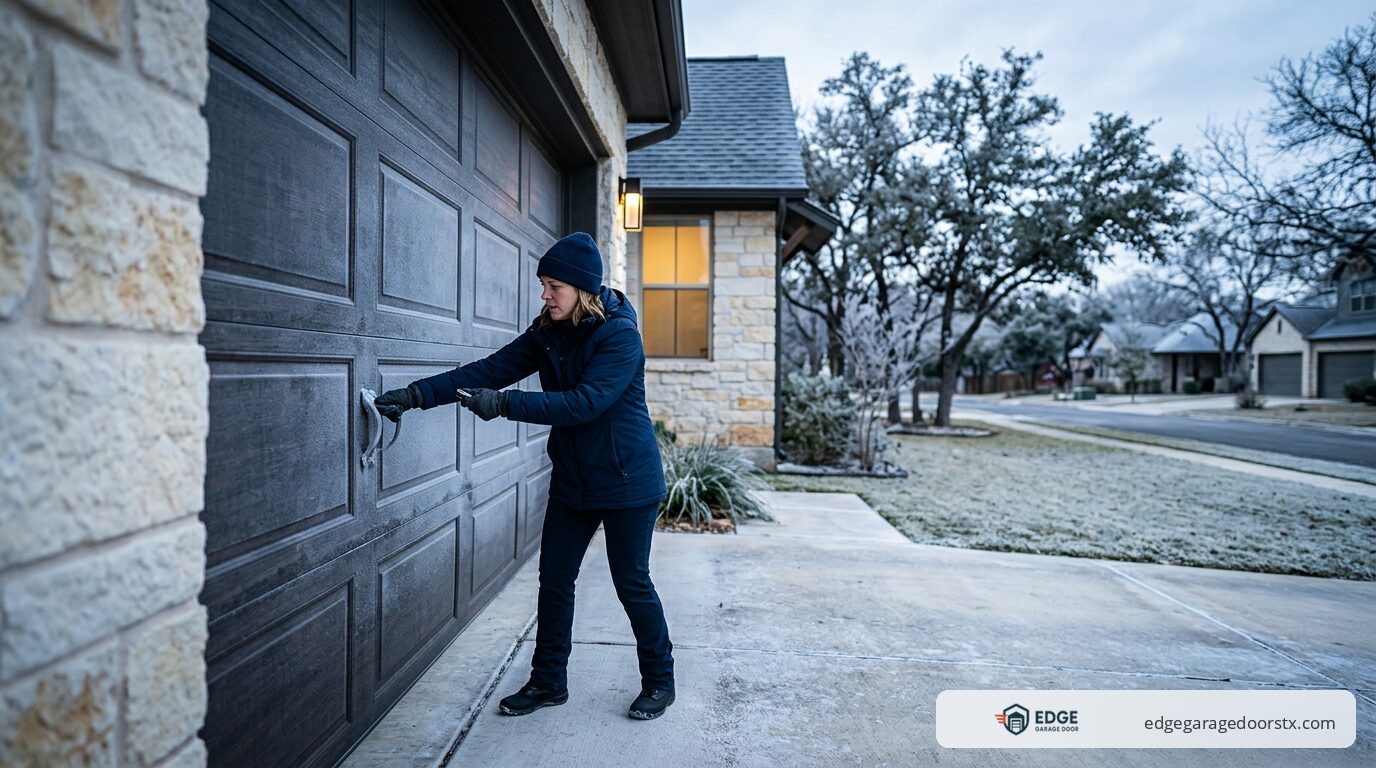
When rain or sleet precedes a freeze in Austin, water accumulates under the rubber weather stripping at the bottom of your garage door. As temperatures drop overnight, this moisture freezes solid, essentially gluing your door to the concrete floor.
Attempting to force the door open with the automatic opener when it’s frozen to the ground can cause catastrophic damage including broken springs, stripped gears, or bent door sections. The door may appear to start opening, then jam suddenly as the frozen seal breaks unevenly.
Safety Sensor Malfunction
Modern garage door safety sensors, required on all openers manufactured after 1993, sit just inches above the floor where cold air settles and moisture accumulates. During Austin’s humid freezes, these sensors experience multiple failure modes that prevent normal operation.
Condensation forms directly on sensor lenses, blocking the infrared beam. Frost buildup creates the same effect. Temperature-related expansion and contraction can knock sensors out of precise alignment. When sensors fail or detect an obstruction (even if none exists), the garage door refuses to close or reverses immediately after attempting to close.
Spring Stress and Failure
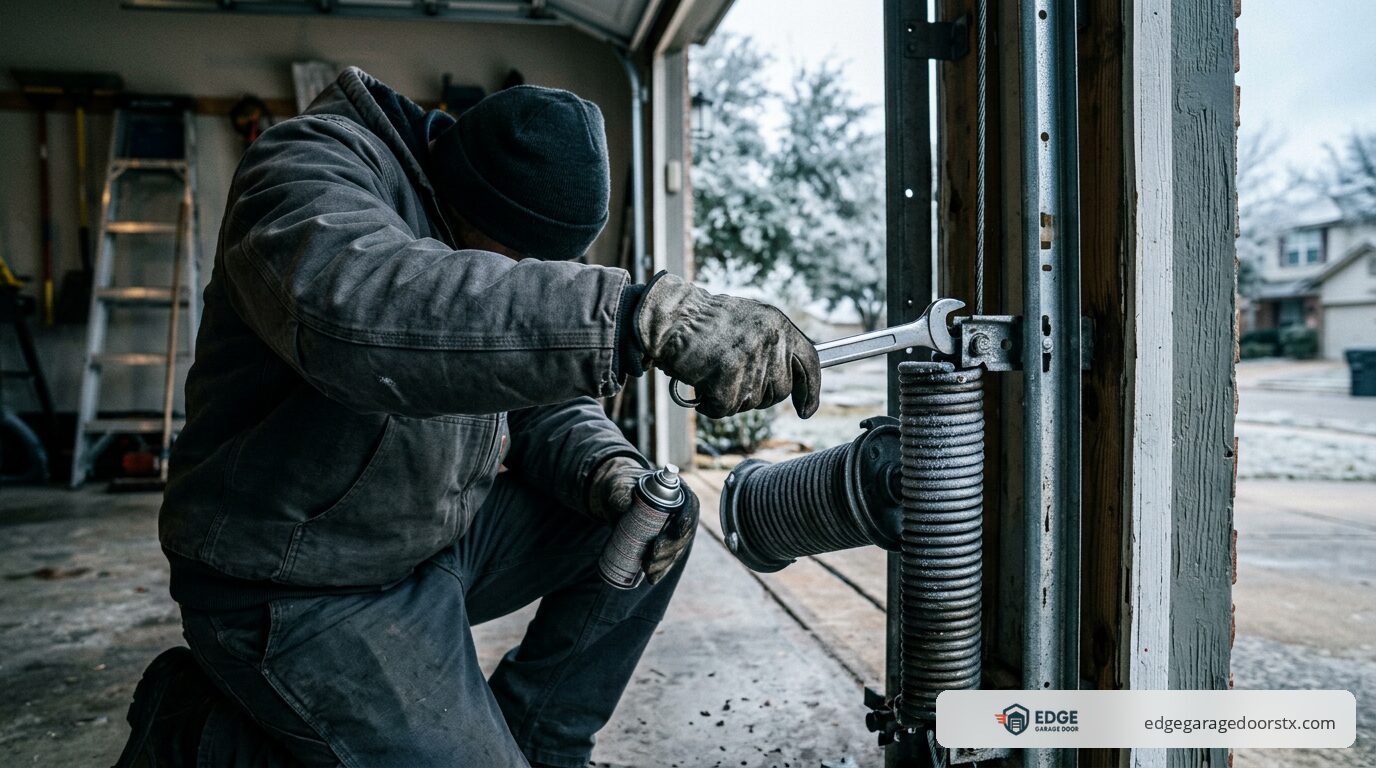
Garage door springs are the most vulnerable component during cold weather events. Torsion springs are pre-tensioned to counterbalance the door’s weight, operating under constant stress. Cold temperatures cause the metal to become more brittle while simultaneously increasing the tension required to lift the door due to other cold-related friction increases.
Springs already near the end of their typical 10,000 to 15,000 cycle lifespan frequently snap during or immediately after freeze events. According to data from Texas garage door repair companies, spring failure rates increase by 400% during the 48 hours following a hard freeze.
| Component | Cold Weather Impact | Failure Rate Increase |
|---|---|---|
| Torsion Springs | Increased brittleness and tension | 400% during freezes |
| Safety Sensors | Condensation and misalignment | 250% in humid freezes |
| Lubricants | Thickening and solidification | Performance degradation in 85% of systems |
What Are the Warning Signs of Cold Weather Garage Door Problems?
Recognizing the specific symptoms helps you identify the underlying cause and take appropriate action before attempting repairs that could cause further damage.
Door Starts Then Stops Immediately
When you press the opener button and the door begins to move upward but stops after just a few inches, you’re likely experiencing one of two problems. Either the door is frozen to the threshold and the opener’s safety mechanism detected excessive resistance, or your springs have failed and can no longer counterbalance the door’s weight.
The opener motor may continue running briefly, creating a humming sound, before the thermal protection circuit shuts it down. Never repeatedly attempt to operate the door when this occurs, as each attempt increases the risk of permanent motor damage.
Unusual Noises During Operation
Cold weather causes distinct auditory changes in garage door operation. Loud screeching or grinding noises indicate solidified lubricant creating metal-on-metal contact in rollers or hinges. A sharp popping or cracking sound during initial movement often signals the breaking of ice bonds at the threshold.
If you hear a sudden loud bang, particularly when the door is not in operation, a spring has likely snapped. This unmistakable sound occurs most frequently during the coldest part of the night or early morning hours when metal reaches its minimum temperature.
Sensor Light Indicators
Most garage door openers feature diagnostic LED lights that indicate sensor status. During cold weather malfunctions, you’ll typically see one or both sensor lights blinking or off completely. The main opener light may flash a specific number of times indicating a sensor obstruction code.
If the door closes partway then immediately reverses, the sensors are detecting what they interpret as an obstacle, even though the path is clear. This phantom obstruction reading almost always results from condensation on sensor lenses or misalignment caused by temperature-related bracket movement.
Visible Frost or Ice Accumulation
Physical inspection often reveals the problem immediately. Frost buildup appears on metal tracks, particularly in uninsulated garages. Ice forms visibly under the rubber weather seal at the door bottom. You may see condensation droplets or ice crystals on sensor lenses.
In two-door garage configurations, one door may operate normally while the other experiences problems, typically because one side receives more direct cold air exposure or has older components more susceptible to temperature stress.
How Do You Troubleshoot a Garage Door That Won’t Open in Freezing Temperatures?
Follow this systematic approach to diagnose and potentially resolve cold weather garage door issues safely. Always prioritize safety over convenience, particularly when dealing with high-tension springs.
Step 1: Disconnect the Automatic Opener
Before attempting any physical manipulation of a stuck garage door, pull the emergency release handle. This red cord hangs from the opener rail and disengages the trolley from the door, allowing manual operation.
Never use the automatic opener to force a frozen or stuck door. The motor lacks the feedback mechanisms to detect ice bonds or mechanical failures, and continued operation can cause $500 to $2,000 in additional damage to the opener motor, drive gears, or door sections.
Step 2: Attempt Manual Operation
With the opener disengaged, try to lift the door manually from the inside. A properly balanced door with functioning springs should lift smoothly with minimal effort, requiring only 10 to 15 pounds of force.
If the door feels extremely heavy and you cannot lift it more than a few inches, you have a broken spring and should immediately stop and contact a professional. According to garage door safety experts, attempting to operate a door with broken springs causes injuries to hundreds of homeowners annually.
If the door won’t budge at all despite reasonable force, it’s frozen to the threshold rather than experiencing a mechanical failure.
Step 3: Address Frozen Threshold Safely
For a door frozen to the floor, never use direct heat sources like propane torches or heat guns, which can damage rubber seals and weather stripping. Instead, use one of these safer approaches:
Mechanical release method: Place a piece of 2×4 lumber against the exterior bottom edge of the door and tap gently with a rubber mallet or hammer, working across the width of the door. The goal is to crack the ice bond without damaging the door panels or seal.
Chemical de-icing: Pour rubbing alcohol (isopropyl) along the seam where door meets floor. Alcohol melts ice at temperatures far below water’s freezing point without harming rubber or paint. Allow 10 to 15 minutes for penetration before attempting to open.
Warm water method: As a last resort in temperatures above 28°F, use lukewarm (not hot) water poured along the seal. This method risks creating new ice if temperatures are too low or if you don’t immediately dry the area after opening.
Step 4: Inspect and Clean Safety Sensors
Safety sensors mounted on either side of the door opening require clear line of sight and clean lenses to function. In cold weather, condensation and frost frequently accumulate on these components.
Wipe both sensor lenses gently with a soft, dry cloth. If condensation persists, use a hair dryer on low heat to evaporate moisture from the sensor housing. Check that both sensor LED lights are illuminated (usually green or red depending on manufacturer) and aligned properly.
Sensors typically mount on adjustable brackets. Verify that the sensors point directly at each other and haven’t been knocked out of alignment by temperature-related expansion or contraction of the mounting hardware.
Step 5: Lubricate Moving Components
Cold-weather appropriate lubrication can restore functionality to a sluggish door. Standard petroleum-based lubricants fail in freezing temperatures, so you need specialized products.
Apply silicone-based or lithium-based spray lubricant specifically rated for low-temperature operation to all rollers, hinges, and springs. These synthetic lubricants maintain viscosity at temperatures down to -40°F, far below anything Austin experiences.
Avoid WD-40 or similar penetrating oils, which provide temporary moisture displacement but inadequate long-term lubrication. Apply lubricant sparingly to prevent drips and buildup that attract dirt.
Step 6: Test Opener Force Settings
If the door operates smoothly by hand but the opener won’t move it, the force sensitivity settings may need adjustment. Most modern openers feature adjustment screws or digital settings controlling up-force and down-force limits.
Cold weather increases operating resistance, sometimes exceeding the factory force settings. Consult your opener manual for adjustment procedures, or consider upgrading to a smart garage door opener with adaptive force control that automatically compensates for weather-related resistance changes.
How Can You Prevent Cold Weather Garage Door Issues in Austin?
Proactive maintenance before Austin’s typical late November to February freeze window prevents the majority of cold-weather garage door failures.
Schedule Professional Pre-Winter Inspection
A comprehensive professional inspection in October or early November addresses potential weaknesses before they become cold-weather failures. Technicians check spring tension and wear, test opener force settings, verify sensor alignment, and assess the condition of rollers, cables, and weather stripping.
Professional garage door installation and maintenance services typically include lubrication with cold-weather appropriate products and adjustment of all moving components to ensure optimal performance during temperature fluctuations.
Apply Weatherproofing to Threshold
The rubber weather seal at the bottom of your garage door deteriorates over time, becoming stiff and cracked. These cracks trap water that freezes during cold snaps. Replace bottom seals showing visible cracks or stiffness.
Consider applying a thin coating of petroleum jelly or silicone spray to the bottom seal before freezing weather arrives. This creates a barrier that prevents ice bonding, allowing easier separation if freezing does occur.
Insulate Unheated Garages
Garage door insulation serves dual purposes in Austin’s climate. It moderates temperature swings during cold snaps, preventing the rapid temperature drops that stress components. It also reduces condensation by keeping the door surface closer to ambient temperature.
Insulated garage doors maintain 10 to 15 degrees warmer interior temperatures during freezes without any additional heating. This temperature buffer keeps lubricants fluid and reduces metal stress from extreme contraction.
Install Cold-Weather Rated Components
If you’re considering upgrades or replacements, specify components rated for extreme temperature operation. Cold-weather torsion springs use specially formulated steel that maintains flexibility at low temperatures. Low-temperature openers feature enhanced motors and gears designed for increased resistance.
These upgrades typically add 15% to 25% to component costs but virtually eliminate cold-weather failures. For homeowners in Austin’s more exposed neighborhoods like Steiner Ranch or Lakeway, where elevation increases freeze exposure, this investment pays dividends.
Monitor and Maintain Proper Lubrication
Establish a quarterly lubrication schedule using silicone or lithium-based products. Focus on all moving metal parts: hinges, rollers, springs, and the chain or screw drive on the opener.
Avoid over-lubrication, which attracts dust and dirt that actually increases friction over time. A light coating that eliminates squeaks and visible dry spots provides optimal performance.
Tasks: Professional inspection, lubrication, seal replacement
Cost: $150 to $400 for comprehensive service
Actions: Clear ice, dry sensors, avoid forced operation
Response time: Address issues within 2 hours of detection
Focus: Spring condition, sensor alignment, lubricant refresh
Prevention: Catches damage before next freeze cycle
When Should You Call a Professional for Cold Weather Garage Door Repair?
While some cold-weather garage door issues resolve with simple DIY troubleshooting, certain situations absolutely require professional intervention. Understanding these boundaries protects both your safety and your investment in the door system.
Broken or Damaged Springs
Spring replacement represents the most dangerous garage door repair. Torsion springs store tremendous energy, with a single spring for a standard two-car garage door holding 200 to 400 pounds of tension.
If you hear a loud bang, see a gap in the spring coils, or find the door impossibly heavy to lift manually, you have a broken spring. Do not attempt DIY repair. According to industry safety data, spring-related injuries send hundreds of homeowners to emergency rooms annually, with finger amputations and severe crushing injuries among common outcomes.
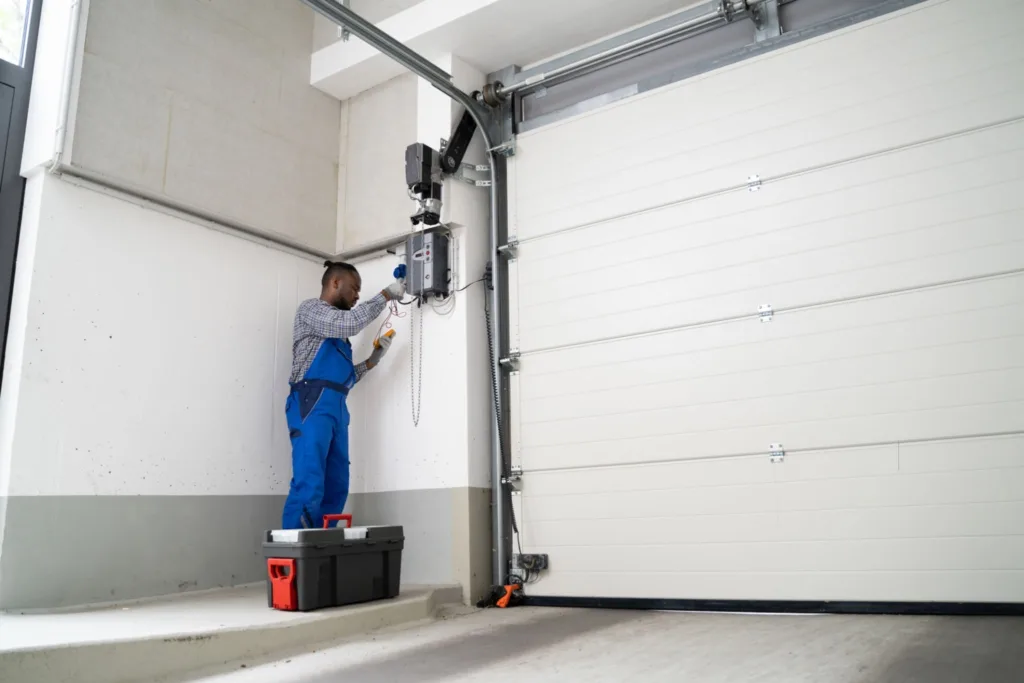
Professional technicians use specialized tools and follow precise procedures to safely remove tensioned springs and install replacements. The service typically completes within 1 to 2 hours and includes balancing adjustments to ensure proper operation.
Bent or Damaged Door Sections
Attempting to force a frozen door open with the automatic opener frequently bends individual door sections, particularly aluminum doors which dent and crease easily. Once bent, sections rarely return to proper alignment and create operational issues even after repairs.
Professional assessment determines whether sections require replacement or if skilled straightening can restore functionality. Door section replacement requires precise matching to existing sections and careful installation to maintain structural integrity.
Opener Motor or Gear Failure
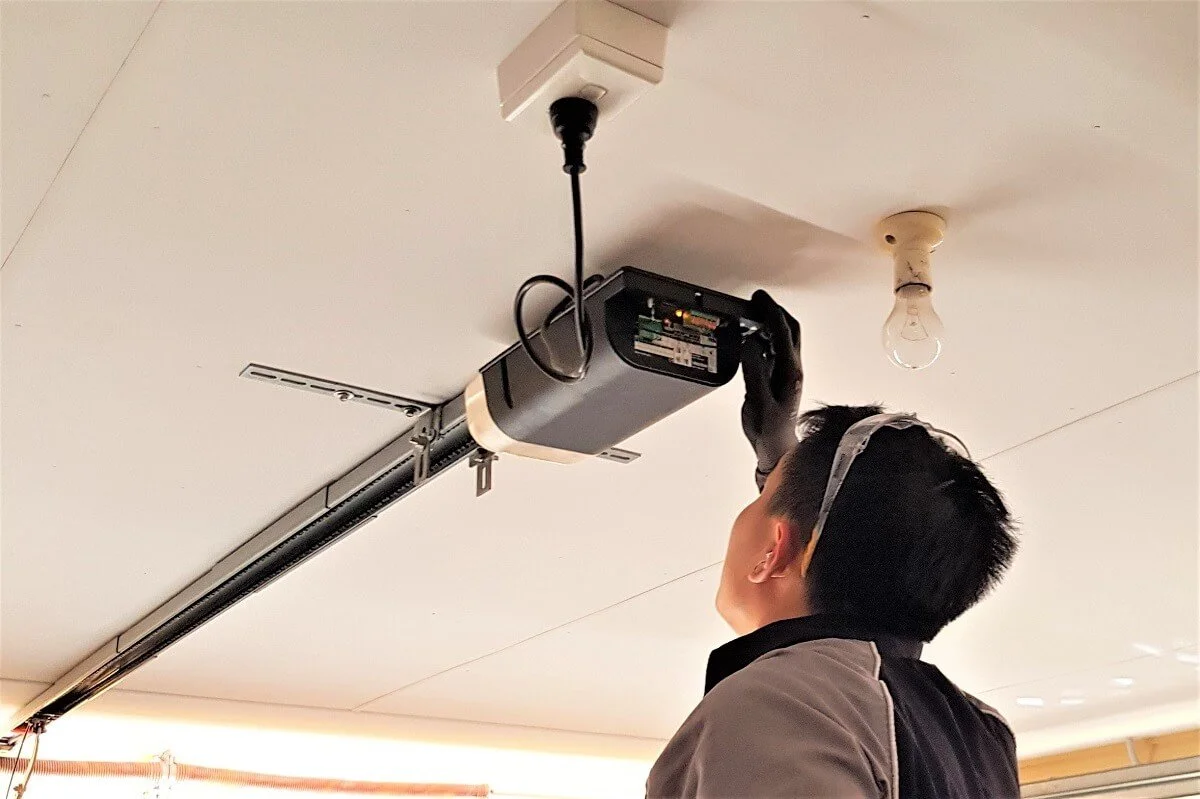
If you hear the motor running but see no movement, or if the opener makes grinding noises, internal gears may be stripped or the motor may have failed. Modern garage door openers contain sealed gear assemblies that require specialized tools and replacement parts.
Opener repair costs vary significantly based on the specific failure, but in many cases with older units, complete opener replacement from experienced professionals proves more cost-effective than repair given improved efficiency and features in modern units.
Persistent Sensor Issues
While cleaning condensation from sensors represents an appropriate DIY task, persistent sensor malfunctions after cleaning and alignment attempts indicate deeper problems. Sensor wiring may have failed, electronic components may have moisture damage, or the sensor units themselves may need replacement.
Professional technicians carry replacement sensors and can diagnose wiring issues that aren’t visible to homeowners. They also have alignment tools that ensure perfect sensor positioning, eliminating the trial-and-error approach of DIY alignment.
What Are the Costs for Repairing Cold Weather Garage Door Damage?
Understanding the financial implications of cold weather damage helps you budget appropriately and make informed decisions about repair versus replacement. Pricing varies significantly based on specific damage, door configuration, and component quality.
Spring Replacement
Torsion spring replacement represents one of the most common cold-weather repairs. Professional spring replacement costs in Austin typically range from $200 to $600 depending on door size, spring quality, and whether you’re replacing a single spring or converting to a dual-spring system for increased longevity.
Premium springs with longer cycle ratings (20,000 to 30,000 cycles versus standard 10,000 cycles) and cold-weather steel formulations cost more initially but provide better value through extended lifespan and reduced failure rates during freeze events.
Sensor Repair and Replacement
Safety sensor issues often resolve with cleaning and realignment at no cost if you perform the work yourself. Professional service calls for sensor adjustment typically cost $100 to $200 including diagnostic time.
Complete sensor replacement, necessary when units suffer moisture damage or electronic failure, ranges from $150 to $350 for quality aftermarket sensors, or $250 to $500 for manufacturer original equipment parts.
Opener Motor Repair or Replacement
Opener motor repair costs depend heavily on the specific failure mode and whether parts remain available for your opener model. Simple repairs like force setting adjustment or gear lubrication may cost $125 to $250. Major repairs involving gear assembly replacement range from $250 to $500.
For openers more than 10 to 15 years old, replacement typically makes more financial sense than repair. New garage door opener installation ranges from $400 to $1,200+ depending on drive type (chain, belt, or screw), motor horsepower, and smart features.
Door Section Replacement
Individual door section replacement costs vary dramatically based on door material, size, and whether matching sections remain available. Steel section replacement for standard doors typically costs $200 to $500 per section, while custom wood or high-end composite sections can run $500 to $1,500+ per section.
For doors requiring multiple section replacements or for older doors where matching sections aren’t available, complete door replacement may prove more cost-effective, with pricing ranging from $1,200 to $5,000+ depending on size, material, insulation, and design complexity.
Weather Seal and Minor Component Replacement
Bottom weather seal replacement represents the most affordable repair, typically costing $75 to $200 professionally installed, or $25 to $60 for DIY installation using purchased seals.
Roller replacement ranges from $10 to $30 per roller for the parts, with professional installation adding $100 to $300 depending on the number of rollers requiring replacement. Quieter nylon rollers cost slightly more than standard steel rollers but significantly reduce operating noise.
Key Takeaways
- Austin’s unique freeze patterns combine rapid temperature drops with high humidity, creating condensation and ice buildup issues distinct from dry northern winters, making garage doors particularly vulnerable during brief cold snaps.
- Metal contraction and lubricant thickening represent the primary mechanical causes when garage doors won’t open in freezing weather, with components contracting measurably and standard lubricants solidifying below 32°F.
- Never force a stuck garage door using the automatic opener, as this can cause extensive damage to motors, gears, springs, and door sections, potentially increasing repair costs from hundreds to thousands of dollars.
- Prevention through pre-winter maintenance proves far more cost-effective than emergency repairs, with professional inspections costing $150 to $400 versus potential repair costs of $500 to $2,000+ for cold weather damage.
- Safety sensors fail frequently during humid freezes due to condensation and frost on lenses, but often resolve with simple cleaning and realignment rather than requiring expensive replacement.
- Professional intervention becomes essential for broken springs, bent door sections, or opener motor failures, as these repairs involve significant safety risks and require specialized tools and expertise.
- Strategic upgrades to cold-weather rated components including insulated doors, low-temperature springs, and silicone-based lubricants virtually eliminate freeze-related failures in Austin’s moderate climate.
People Also Ask
Why won’t my garage door open when it’s cold outside?
Cold weather causes metal components to contract, lubricants to thicken or solidify, and moisture to freeze at the door threshold or on safety sensors. These physical changes create resistance that prevents normal operation, with the door either refusing to move or moving only partially before stopping.
Can I use hot water to unfreeze a stuck garage door?
Lukewarm water can work in temperatures above 28°F, but hot water risks damaging rubber seals and can create more ice if ambient temperatures are too low. Safer alternatives include rubbing alcohol poured along the frozen seal or gentle mechanical separation using a 2×4 and rubber mallet.
How cold does it have to be for a garage door to freeze?
Garage doors can experience cold-weather issues whenever temperatures drop below 32°F, particularly if moisture is present. In Austin’s humid climate, problems often begin at 35°F to 38°F when condensation forms and then freezes as temperatures continue dropping overnight.
Should I disconnect my garage door opener in freezing weather?
Only disconnect the opener using the emergency release cord if the door won’t open or appears stuck. Operating a frozen or mechanically compromised door with the automatic opener can cause severe damage to both the door and opener mechanism.
What type of lubricant should I use on my garage door in winter?
Silicone-based or lithium-based spray lubricants rated for low-temperature operation maintain proper viscosity down to -40°F. These synthetic products significantly outperform petroleum-based lubricants that thicken or solidify at freezing temperatures.
How much does it cost to fix a garage door that won’t open in cold weather?
Repair costs range from $0 for DIY sensor cleaning to $2,000+ for major component replacements including springs, openers, or door sections. Simple service calls typically cost $100 to $300, while spring replacements range from $200 to $600, depending on door size and spring quality.
Frequently Asked Questions
How often should I lubricate my garage door to prevent cold weather problems?+
Lubricate all moving components quarterly using cold-weather rated silicone or lithium spray lubricant. Focus on rollers, hinges, springs, and the opener drive mechanism. Apply additional lubrication before expected freeze events, typically in late November before Austin’s first cold snap.
Can insulating my garage door prevent cold weather operation problems?+
Yes, insulated garage doors moderate temperature swings and maintain 10 to 15 degrees warmer temperatures during freezes, which keeps lubricants fluid and reduces metal stress from rapid contraction. Insulation also minimizes condensation that leads to ice formation on sensors and weather stripping.
Why do my garage door sensors keep malfunctioning in cold weather?+
Sensors positioned near the floor accumulate condensation and frost on lenses during Austin’s humid freezes, blocking the infrared safety beam. Temperature changes also cause bracket expansion that knocks sensors out of precise alignment. Regular cleaning and verification of proper alignment prevents most cold-weather sensor issues.
Is it normal for my garage door to make more noise in cold weather?+
Increased noise during cold operation typically indicates thickened lubricant creating more friction in rollers and hinges. While some additional noise is normal, loud screeching or grinding sounds warrant immediate attention and re-lubrication with cold-weather appropriate products to prevent component damage.
Should I replace my garage door springs before they break during cold weather?+
Yes, proactive spring replacement makes sense if your springs are approaching their rated cycle life of 10,000 to 15,000 cycles, typically 7 to 10 years of normal use. Springs near end-of-life are far more likely to fail during freeze events when metal becomes brittle and tension increases.
What should I do if my garage door won’t close but opens fine in cold weather?+
This symptom almost always indicates safety sensor malfunction from condensation, frost, or misalignment. Clean both sensor lenses thoroughly, verify they’re pointed directly at each other, and check that both LED indicator lights show solid illumination. If problems persist after cleaning and alignment, sensors may require replacement.
How long do garage door repairs take after cold weather damage?+
Simple repairs like spring replacement or sensor adjustment typically complete within 1 to 2 hours. More extensive repairs involving opener replacement or multiple door sections may require 2 to 4 hours. Emergency service availability during and immediately after freeze events varies, so contact professionals as soon as you identify problems rather than waiting.