
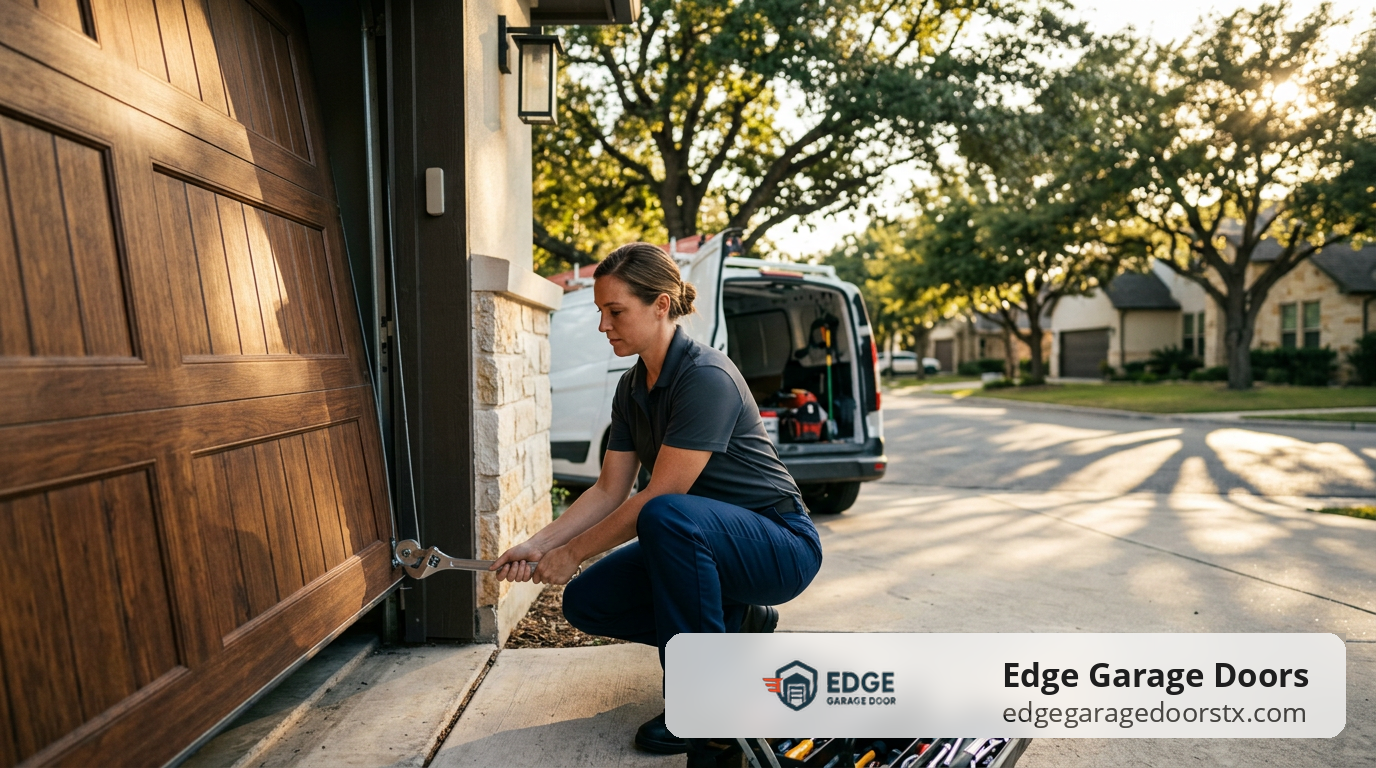
Garage door emergency repair signs are indicators that your door poses an immediate danger or has left your home unsecured, requiring same-day professional attention. Most homeowners treat a malfunctioning garage door as a minor inconvenience, but the real standard is simpler: emergency is defined by immediate danger or home security risk, not by how annoying the problem is. A door that won’t close, a spring that snapped with a loud bang, or cables hanging slack off their drums all qualify. Recognizing these garage door malfunction indicators before you make the situation worse is the difference between a single service call and a much larger repair bill.
7 critical garage door emergency repair signs you must never ignore
The following signs go beyond normal wear. Each one signals a mechanical failure that puts people, vehicles, or your home’s security at risk right now.
1. A loud bang followed by a door that won’t move
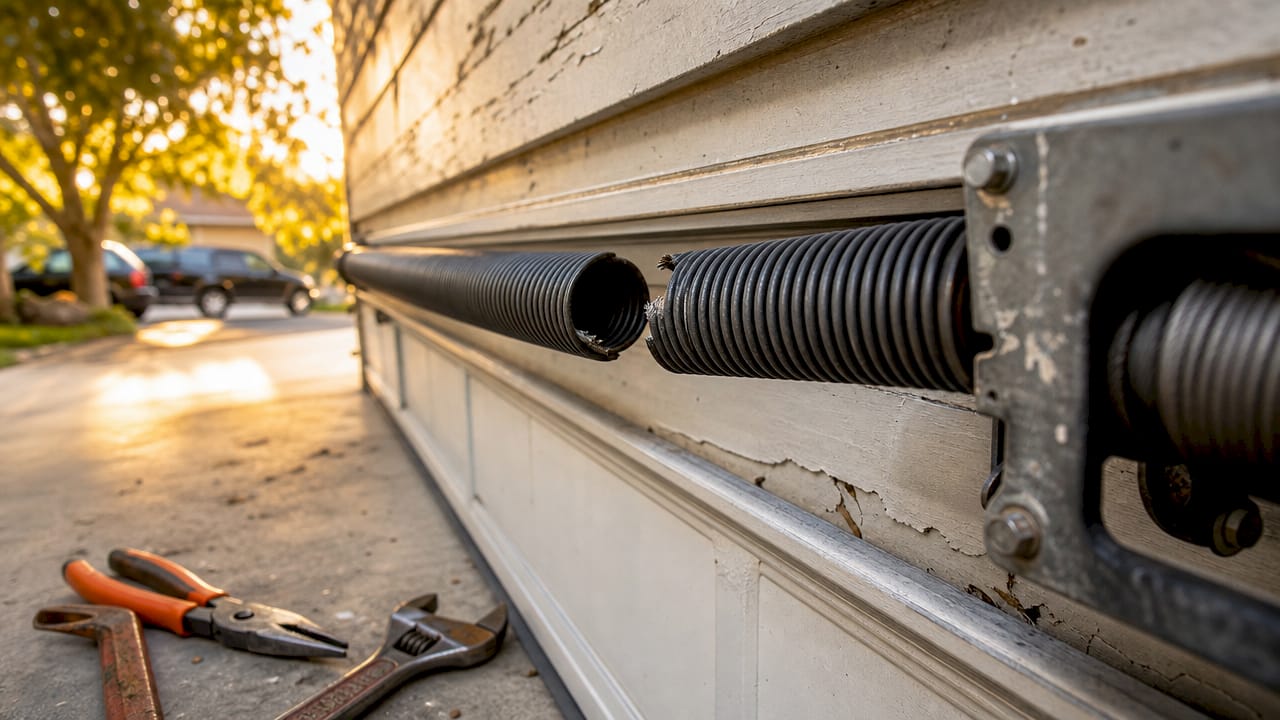
A sudden, explosive bang from the garage is the classic sign of torsion spring failure. The spring coil separates, and you will often see a visible gap in the spring above the door. This is not a noise issue. A broken torsion spring means the door has lost its counterbalance, and a standard residential door can weigh over 150 lbs without that support. Forcing the opener at this point risks burning out the motor entirely, turning a spring replacement into a spring-plus-opener replacement.
2. The opener runs but the door doesn’t move
When you hear the opener motor running but the door sits completely still, the most common culprits are a broken spring or a snapped cable. Many homeowners assume the opener itself has failed, but spring failure is frequently confused with opener failure. The distinction matters because the fix is completely different. Check for a visible gap in the torsion spring above the door or slack cables hanging off the side drums before calling for service. That information helps a technician arrive prepared.
3. Door falls or slams shut unexpectedly
A door that drops suddenly instead of lowering in a controlled motion has lost cable tension or spring support on one or both sides. Broken cables cause the door to hang unevenly and create a serious pinch and crush hazard for anyone standing nearby. This is one of the highest-risk emergency garage door issues because the failure can happen mid-cycle with no warning. Clear the area immediately and do not attempt to operate the door again.
4. Door is off its track or hanging at an angle
A door that has jumped its track and sits visibly crooked is under extreme mechanical stress. The highest risk scenario occurs when the door is partially open with cables and springs still under load, because small triggers can cause sudden collapse. Repeated attempts to cycle the opener make this worse, not better. This is a clear emergency repair sign that requires a technician to relieve the tension safely before any realignment work begins.
5. Door is stuck open overnight or for an extended period
A door stuck in the open position is the most common emergency call that garage door companies receive. A stuck-open door compromises home security and should be treated as an urgent situation, not something to deal with tomorrow. Your garage connects directly to your home’s interior in most cases. Leaving it open overnight exposes your vehicles, tools, and the interior entry door to anyone walking by. Same-day or emergency dispatch is the correct response here.
6. You cannot manually lift the door safely
Every garage door should be liftable by hand when the opener is disconnected via the emergency release cord. If the door feels impossibly heavy, rises only a few inches and drops back, or tilts to one side when you try to lift it, the spring or cable system has failed. Manually lifting a door with a broken spring is dangerous because the door can drop without warning. Test the manual lift only once and gently. If it does not move smoothly, set it down and call for service.
7. Photo-eye sensors are blinking or the door reverses immediately
The photo-eye sensors mounted near the floor on both sides of your door are required safety devices under UL 325. Sensors must be mounted under 6 inches from the floor and properly aligned, with steady indicator lights showing correct function. A blinking LED on either sensor means the beam is interrupted or misaligned. The door will refuse to close or will reverse immediately after starting. While dirty lenses are sometimes the cause, a sensor that stays misaligned after cleaning points to a bracket impact or wiring issue that needs professional diagnosis. You can review the full process for sensor alignment in Austin if you want to understand what a technician checks.
How to safely assess these signs without making things worse
When you spot any of the emergency signs above, your first move is to stop using the door. Do not press the remote again hoping it will work this time. Forcing the opener on a failed door strains the motor and can cause total opener failure on top of the original problem.
Follow this checklist before calling a technician:
- Stop all operation. Disconnect the opener by pulling the red emergency release cord hanging from the trolley rail. This disengages the door from the drive mechanism.
- Clear the area. Keep children, pets, and vehicles away from the door and the driveway directly in front of it.
- Do not pull cables. Cables are under significant tension even after a spring failure. Touching them without training causes injury.
- Do not attempt repeated manual lifts. One gentle test is acceptable. Multiple attempts on a damaged door shift components further out of position.
- Take photos. Photograph the spring, cables, track, and the door position from multiple angles. This helps the technician triage the job before arrival.
- Secure the interior entry door. If the garage door is stuck open, lock the door between your garage and your home immediately.
Pro Tip: If your door is stuck open and you cannot get same-day service, a temporary solution is to zip-tie the emergency release cord to the trolley so the door cannot be manually pushed open from outside. This does not fix the problem, but it reduces the security risk while you wait.
Understanding what causes these signs and why delays cost more
The mechanical failures behind these emergency signs follow a predictable pattern. Torsion springs store enormous energy and release it all at once when they break, which is why the failure sounds like a gunshot. Cables share the spring load across both sides of the door, so when one snaps, the door tilts and the remaining cable takes on uneven stress. Left unaddressed, that second cable fails shortly after.
| Emergency sign | Root cause | Risk of delaying repair |
|---|---|---|
| Loud bang, door won’t move | Torsion spring fracture | Opener motor burnout, door drop hazard |
| Door tilts or hangs unevenly | Snapped cable, drum failure | Second cable failure, door collapse |
| Off-track door | Roller bracket failure, impact | Sudden collapse under spring tension |
| Opener runs, door stays still | Spring or cable failure | Progressive opener damage |
| Sensors blink, door reverses | Misalignment, dirty lens, wiring | Door closes on people or objects |
Photo-eye sensors represent one safety layer, but mechanical force reversal is an independent protection system that also needs to function correctly. A door with failed sensors and a failed force reversal setting is genuinely dangerous. Partial failures in any of these systems also strain the opener motor, which is why a single broken spring that gets ignored for two weeks often results in a spring replacement plus an opener replacement.
When and how to call for emergency garage door repair
Not every garage door problem is a true emergency. A door that makes a new grinding noise but opens and closes fully is urgent but not an emergency. A door that is stuck open, has a broken spring, or is off its track qualifies as an emergency. The practical test: ask whether anything is under tension and could move unpredictably, or whether your home is currently unsecured. Yes to either means you call now.
When you call for 24/7 emergency repair service, give the dispatcher the following information:
- The current position of the door (fully open, partially open, closed but won’t move)
- Any noises you heard before or during the failure
- Whether anyone or any vehicle is trapped or blocked
- Visible damage you can describe (gap in spring, slack cables, door angle)
- Photos sent via text if the company accepts them
Detailed symptom descriptions and photos allow the dispatcher to prioritize your call correctly and send a technician with the right parts. A technician arriving without the correct spring size wastes everyone’s time. Before the technician arrives, clear the garage of vehicles if possible, have the garage door model number ready (usually on a sticker inside the opener unit), and make sure the work area is accessible.
Key takeaways
Garage door emergencies require immediate action because the underlying mechanical failures create danger and security risks that worsen with every hour of delay.
| Point | Details |
|---|---|
| Stop operation immediately | Never force or repeatedly cycle a door showing emergency signs. |
| Spring failure is the most dangerous sign | A broken torsion spring makes the door dead weight and risks sudden drop. |
| Stuck-open doors are security emergencies | Lock the interior entry door and call for same-day service. |
| Photos speed up dispatch | Send images of the spring, cables, and door position when you call. |
| Delays multiply repair costs | One failed component strains others, turning single repairs into multiple replacements. |
What I’ve learned from watching homeowners handle garage door emergencies
The most common mistake I see is the “one more try” approach. The door doesn’t move, so the homeowner hits the remote button five more times, then walks over and yanks the handle, then tries the wall button. By the time a technician arrives, what started as a clean spring break has become a bent track, a stripped opener gear, and a cable that shifted off its drum. The original repair doubled in cost because of three minutes of impatience.
The second mistake is underestimating how heavy a garage door actually is without spring support. People assume they can hold it up while someone else looks underneath. A 150-plus-pound door with no counterbalance drops fast and does not care about your hands or feet. I have seen the consequences of DIY spring repair attempts go badly enough that I will never soften the message: this is not a weekend project.
What does work is simple maintenance that prevents most emergencies from happening at all. Lubricate the torsion spring, rollers, and hinges with a garage door specific lubricant twice a year. Listen for changes in sound during normal operation. A door that starts grinding or squealing is telling you something weeks before it fails completely. Catching a worn roller or a fraying cable during a tune-up costs a fraction of what an emergency call costs at 9 PM on a Sunday.
The homeowners who avoid emergencies are not lucky. They pay attention and act on early warning signs before those signs become a door on the floor.
— Oded
Edge Garage Doors is ready when your door isn’t
Edge Garage Doors serves Austin, Cedar Park, Leander, Round Rock, and surrounding Central Texas communities with fast, honest emergency garage door repair. When your spring snaps at 7 AM or your door refuses to close before you leave for work, the team arrives prepared with the right parts and a straight answer about what it costs. No pressure, no upselling parts you do not need. Edge Garage Doors also offers preventative tune-ups that catch fraying cables, worn rollers, and weakening springs before they become a crisis. Check the emergency repair service page for availability, or review the immediate repair warning signs guide to assess your situation right now.
FAQ
What counts as a true garage door emergency?
A true emergency is any situation where the door poses immediate physical danger or leaves your home unsecured. Broken springs, off-track doors, stuck-open doors, and snapped cables all qualify.
Can I manually open my garage door if the spring is broken?
You can attempt one gentle manual lift after disconnecting the opener via the emergency release cord, but a door with a broken spring can weigh over 150 lbs and may drop without warning. Call a technician rather than forcing it.
Why does my opener run but the door not move?
This almost always means a broken torsion spring or snapped cable has disconnected the mechanical load from the opener drive. The opener motor is running, but there is nothing for it to move. Stop cycling the opener to avoid motor damage.
How do I know if my photo-eye sensors are causing the problem?
A blinking LED on either sensor unit indicates a misalignment or obstruction. Sensors reverse the door within 150 to 250 milliseconds of beam interruption. Clean the lenses first. If the light stays blinking after cleaning, the bracket or wiring needs professional inspection.
How quickly should I expect a technician for an emergency call?
Most reputable emergency garage door repair services in the Austin area offer same-day or within-hours response for true emergencies. Providing the door position, visible damage, and photos when you call speeds up dispatch and helps the technician arrive with the correct parts.
Recommended
- 5 Warning Signs Your Garage Door Needs Immediate Repair
- Most Common Garage Door Opener Repair Mistakes Homeowners Make
- How Garage Door Repair in Austin, TX Saves You from Costly Home Emergencies (Expert Guide by Edge Garage Door)
- Why Garage Door Repair in Austin, TX Is Essential for Home Safety and Security