
Will a 16-Foot Garage Door Fit My Truck in Austin TX
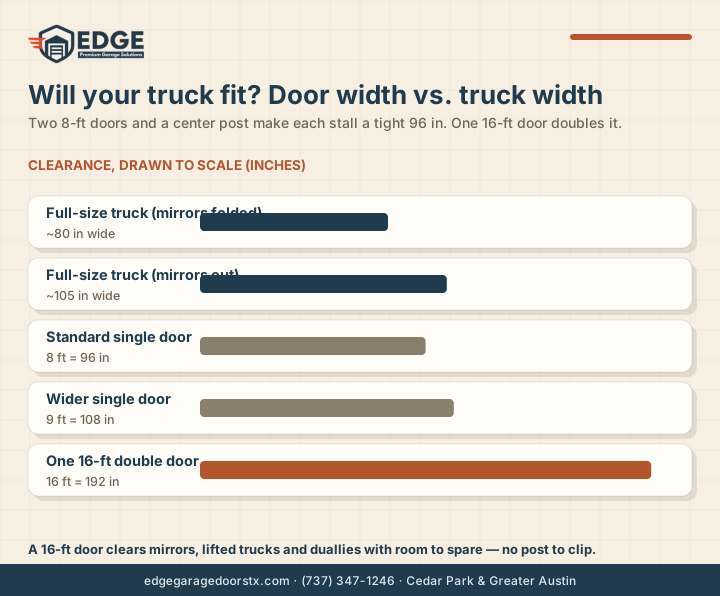
Yes — a 16-foot garage door fits any truck, including a lifted one or a dually. A 16-foot door is a 192-inch clear opening. A full-size pickup is roughly 80 inches across the body and about 105 inches mirror-to-mirror, so you have feet of room, not inches. If your truck barely fits today, the real culprit isn't the truck — it's a narrow 8-foot single door and the center post right next to it. Take the post out, replace it with one wide door, and you stop folding mirrors and holding your breath for good.
From a recent Edge job: A homeowner in the Leander area had a lifted F-250 and kept clipping the same mirror on the center post backing in. We converted two 8-ft doors into one 16-ft door on a new header beam — now the truck drives in dead center with room on both sides (2026).
Will a 16-foot garage door fit my truck?
Comfortably — and here's the math so you don't have to guess. A 16-foot door gives you a 192-inch clear opening. Measure your truck two ways: the body width (a full-size pickup is around 80 inches) and the mirror-to-mirror width with the mirrors folded out (roughly 100 to 105 inches on most half-tons and three-quarter-tons). Even at the wide end, you're parking a 105-inch truck through a 192-inch hole. That's not "just fits" — that's park-anywhere-across-the-opening room. The reason a truck feels tight now is almost never the door height or the truck itself; it's that a single 8-foot door is only 96 inches wide, and half of that gets eaten by the post and the parked position.
How wide should a garage door be for a lifted truck?
If you've got a lift, a dually, or wide tow mirrors, go straight to a 16-foot opening. A lift kit and fender flares push your widest points — the mirrors and the tires — closer to the door edges, which is exactly where people scrape on a single door. On a 9-foot door you might squeak in on a good day, but you're aiming a moving truck at a 12-inch margin every single time. Sixteen feet takes the margin from inches to feet, so a lifted truck, a boat trailer, or a work van all clear without the daily anxiety. If you're not sure your specific truck fits your current opening, measure mirror-to-mirror and compare it to the numbers in the diagram above — then call us with the width and we'll tell you straight.
Does removing the center post help a truck fit?
The post is usually the entire problem. Two single doors with a post between them don't give you a two-car opening — they give you two separate 96-inch stalls, and the post steals the very inches your mirror needs when you back in or pull out at an angle. That's why people say they "keep clipping the middle post": it's a daily irritation, not a rare one. On a two-to-one conversion we temporarily shore the ceiling, remove the post, and transfer its load onto a properly sized header beam that spans the full width. The two cramped stalls become one clean 16-foot opening — no post, no lane to thread, no folded mirrors.
Is the center post load-bearing — and is this safe?
Usually yes, the post carries part of the roof or the floor above, and that's completely routine for a conversion. It doesn't mean you're stuck with it; it means the load has to go somewhere before the post comes out. We install a header beam sized to your specific span, shore everything first, and build to code — a two-to-one conversion in the Austin area typically needs a permit and inspection, and Edge handles that as part of the job. You get one written price up front that includes the structural work, so there are no surprises. (For the full structural picture, see our post on whether a conversion needs a structural engineer.)
What does a wide-door conversion cost?
Two parts: the new wide door, which starts at $1,650 installed, and the structural work to remove the post and set the header, which we quote after seeing your specific wall — every header and load is different. You get one combined written price before anything starts, and most conversions are finished in a single day. See our two-to-one conversion service for the full walkthrough.
Will my truck fit a 16-foot door? — FAQs
Will a 16-foot garage door fit my truck?
Yes — comfortably. A 16-foot door gives you a 192-inch clear opening. A full-size pickup is about 80 inches across the body and roughly 105 inches mirror-to-mirror, so you have several feet to spare, even with the mirrors out. The problem was never the truck — it was the narrow single door and the post beside it.
How wide should a garage door be for a lifted truck?
For a lifted truck, a dually, or a truck with wide tow mirrors, aim for a 16-foot opening. Lifts and flares push you toward the edges of a single 8- or 9-foot door, where you clip mirrors and door edges. Sixteen feet removes the guesswork — you drive in centered without holding your breath.
Does removing the center post help a truck fit?
That post is usually the whole problem. Two 8-foot doors with a post between them give you two 96-inch stalls, and the post steals the inches your mirror needs. Remove it, carry the load on a header beam, and the two stalls become one 192-inch opening. That's the conversion that finally fits the truck.
Is a 16-foot door better than two 8-foot doors for parking?
For trucks and SUVs, yes. One 16-foot door lets you park anywhere across the opening instead of threading two narrow lanes, so you stop clipping mirrors and door dings. Two singles can look fine on a small car garage, but if your truck barely fits today, the wide door is the upgrade you feel every day.
A conversion doesn't have to be paid all at once. Edge is one of the few local garage door companies offering 0% APR financing for qualified buyers (660+ credit) through Hearth — checking your rate won't affect your credit. See payment options →
Tired of folding the mirror every time you pull in? Call Edge Garage Doors at (737) 347-1246 or request a quote for an on-site measure and a written price. We're local, insured, and back our work with a 3-year parts and 90-day labor warranty — serving Leander, Cedar Park, Round Rock, and the wider Austin area. Ready to size it up? Start with our two-to-one conversion page.